If you’re tired of replacing washers and dryers every few years, you’re not alone. Most residential appliances are engineered for light to moderate use, which is why homeowners with larger families, active lifestyles, or heavy laundry demands often face premature breakdowns. Maytag commercial washer and dryer units offer a different approach, they’re built for the high-capacity demands of laundromats and commercial facilities, but increasingly, serious DIY homeowners are installing them at home. These machines deliver heavier construction, longer warranties, and genuine durability that outlasts typical household appliances by years. This guide walks you through what makes Maytag commercial equipment worth considering, how to install it properly, and what maintenance keeps it running strong.
Table of Contents
ToggleKey Takeaways
- Maytag commercial washers and dryers are built for 24/7 commercial use, making them ideal for homeowners with heavy laundry demands who want appliances lasting 15+ years instead of 8.
- Commercial models come with 5–7 year warranties on parts and labor, feature sturdier construction with cast-iron pumps and stainless-steel components, and have fewer circuit boards—meaning greater mechanical reliability and lower repair costs.
- Proper installation requires 240V electrical service with a 30-amp dedicated breaker, ½-inch water supply lines, and ¾-inch minimum drain lines to handle the higher water volumes of Maytag commercial equipment.
- Commercial dryers demand proper 4-inch venting (not flexible ductwork) and monthly lint trap cleaning plus quarterly vent inspection to prevent fire hazards and maintain consistent drying efficiency.
- While upfront costs range from $3,500–$8,000 for a Maytag commercial washer-and-dryer pair, the extended lifespan, reduced repairs, and simpler mechanical design often justify the investment for families with active lifestyles or laundry services.
Why Choose Maytag Commercial Equipment for Your Home
Commercial-grade washers and dryers aren’t designed for everyday homeowners, they’re built for facilities processing 50+ loads per day. But that over-engineering means they handle residential use with room to spare. Maytag commercial models use sturdier drum assemblies, heavier-gauge steel components, and more robust motor systems than consumer-grade machines. When a machine is rated to run 24/7 in a commercial setting, a typical household putting through 10–15 loads weekly barely stresses it.
The warranty difference tells the real story. Standard residential washers often carry 1–3 year warranties: Maytag commercial units come with 5–7 year warranties on parts and labor, reflecting manufacturer confidence in longevity. Parts are also more readily available and standardized across the commercial line, making repair easier if something does go wrong. And because these machines are engineered for simplicity over fancy features, there’s less to break, no smart-home connectivity, fewer circuit boards, more mechanical reliability.
If you have a large family, run a home-based laundry service, do athletic or outdoor work regularly, or simply want appliances that last 15+ years instead of 8, the upfront cost premium ($2,000–$4,500 for a washer, $1,500–$3,500 for a dryer) often pays for itself through reliability and extended service life.
Key Features of Maytag Commercial Washers
Heavy-Duty Construction and Performance
Maytag commercial washers come in top-load and front-load configurations, with capacity typically ranging from 4.7 to 5.5 cubic feet, significantly larger than residential models (usually 3.5–4.2 cu. ft.). The extra volume means fewer loads per week and faster laundry processing. The porcelain or stainless-steel tub resists rust and corrosion far better than galvanized steel used in consumer machines, and the cast-iron pump is a throwback to proven engineering that outlasts plastic components.
The wash action itself is different. Commercial agitators operate at a lower speed with more rinsing cycles, pulling dirt from fabric more thoroughly without the aggressive tumbling that causes wear on delicate items. Water level controls are often manual rather than sensor-based, giving you direct control, if you want extra water for heavily soiled bedding, you dial it in without relying on electronics to make the choice. Cycle times are straightforward: regular, delicate, heavy-duty, no 47 preset variations burying the settings you actually need.
Automatic detergent dispensers and overflow safeguards prevent sudsing issues common in homes with soft water or high-efficiency detergent use. The best top-loading washing machines include Maytag commercial models as top performers, with testers praising their cleaning power and load capacity. Stainless-steel fasteners and reinforced mounting points mean the machine doesn’t rattle or shift during spin cycles the way lighter units do.
Key Features of Maytag Commercial Dryers
Energy Efficiency and Quick Drying Technology
Commercial dryers operate differently from residential ones. Rather than relying on moisture sensors and extended drying times, they use straightforward temperature control and a durable, oversized heating element. Maytag commercial dryers typically offer 5.5–7 cubic feet of capacity (compared to 4.5–5.5 cu. ft. residential) and are rated for extended duty cycles. The larger drum dries more clothes per load, and the high-capacity airflow system pulls moisture efficiently without creating hot spots.
Energy efficiency in commercial models focuses on consistent, predictable drying rather than adaptive electronics. Many lack the moisture-sensing tech found in residential units, which can fail over time. Instead, you set a temperature (low, medium, high) and drying time, then walk away knowing the machine will dry your load reliably. The stainless-steel exterior and interior components resist corrosion from lint and humidity, extending service life in damp laundry rooms.
Venting is critical here: commercial dryers demand proper installation into a full-size dryer vent (4-inch minimum, not flex ductwork prone to blockage). The exhaust airflow is higher than residential models, so undersized ductwork creates backpressure, reducing efficiency and increasing drying time. A clean lint trap after every load, plus quarterly vent cleaning, keeps performance consistent and prevents fire risk, commercial use demands the same diligence residential guidelines recommend but more people actually follow.
Installation and Space Considerations
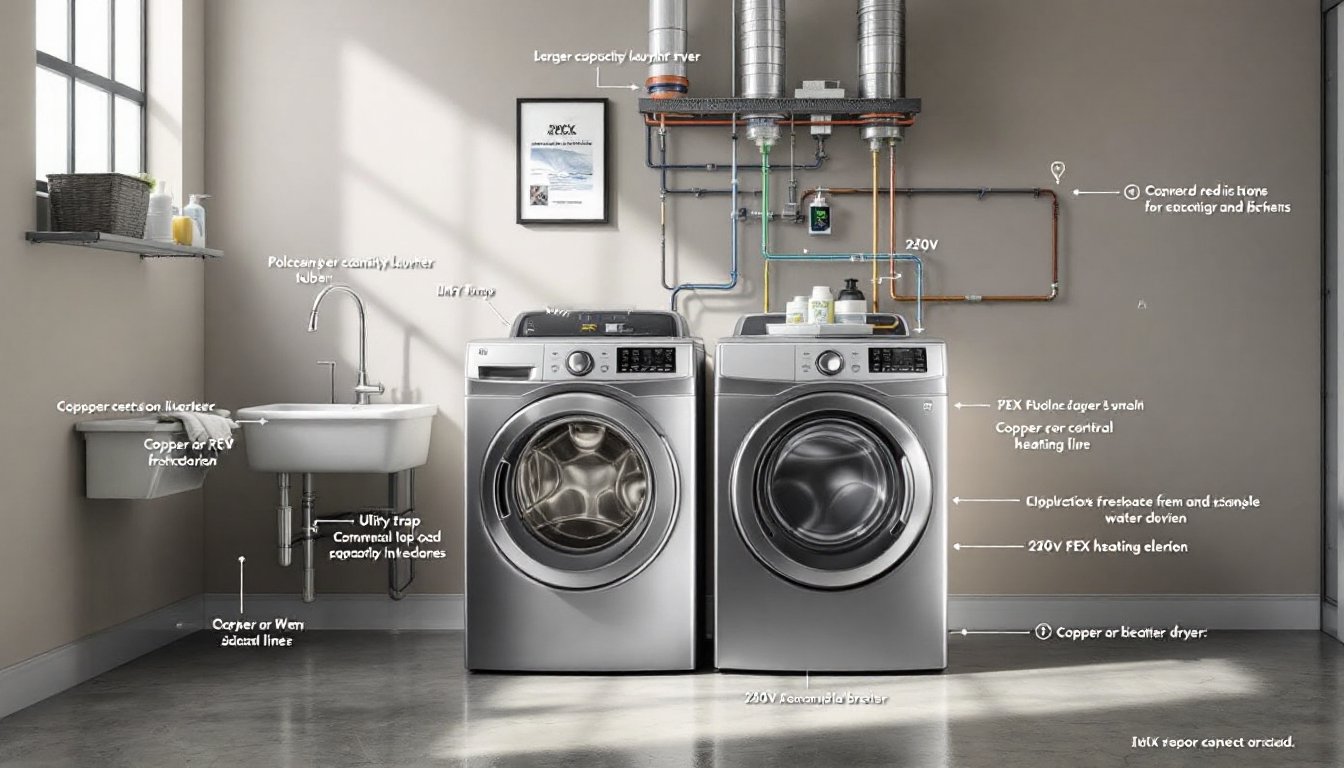
Installing a Maytag commercial washer and dryer at home requires honest assessment of your laundry space. These units are significantly heavier than residential models, a commercial top-load washer weighs 350–500 pounds, and dryers add another 300–450 pounds. Your floor must be level and solid: settling floors or soft subfloors under uneven loads cause vibration and potential structural stress over years of use.
Electrical requirements differ by model: top-load washers typically run on standard 120V household current, but dryers require either 240V or 208V (depending on commercial specification). Check your existing outlet and breaker capacity. A 240V dryer circuit should use a 30-amp dedicated breaker: undersizing creates fire hazard. If your panel lacks capacity, a licensed electrician must upgrade it, this isn’t a DIY fix and likely requires a permit and inspection.
Plumbing must handle higher water volumes. Commercial washers fill faster and use more water per cycle than residential models. Your supply lines should be ½-inch copper or PEX minimum: ⅜-inch lines create pressure drops and slow fill times. The hot and cold lines should be insulated if routed through unheated spaces, temperature control depends on consistent water temperature at the machine inlet. Drain capacity is equally critical: a ¾-inch drain line is minimum: larger machines may need a 1-inch line to prevent backflow and slow drainage.
Stand-alone utility sinks near the washer simplify pre-rinsing heavily soiled items. If your laundry room lacks dedicated water hookups, professional plumbers can typically add them: budget $1,500–$3,000 for supply, drain, and vent lines if running rough-in from distant supply lines. Verify building codes in your jurisdiction, some municipalities require permits for appliance installation, especially when electrical or plumbing work is involved. A permit also triggers an inspection, catching code violations before they become expensive problems.
Maintenance Tips to Extend Equipment Lifespan
Commercial washers and dryers are simpler mechanically than residential units, but proper maintenance still matters. Clean the washer’s agitator and tub monthly by running a hot-water cycle with a commercial washing machine cleaner (brands like OxiClean or commercial-specific products work well). Lint and detergent residue accumulate in crevices, reducing efficiency and inviting mold. For top-load machines, leave the lid open after each load for 30 minutes to air-dry the interior.
Inspect hoses and connections quarterly. Rubber inlet hoses degrade over time: replace them every 5 years or immediately if you notice bulging, cracks, or discoloration. Stainless-steel braided hoses last longer and resist bursting, though they cost more upfront. Drain lines should be checked for kinks, blockages, or standing water, a slow drain often precedes complete clogging.
Dryer maintenance hinges on venting. Remove lint from the trap after every load (this is non-negotiable, lint buildup is a fire hazard). Run a vent-cleaning brush through the external vent duct at least quarterly, or monthly if you dry heavy loads frequently. Inspect the vent hood outside for nesting animals or debris. If drying times creep up, usually the vent is partially blocked. A duct borescope camera ($30–$60) lets you see inside ducts without dismantling them, saving diagnostic time.
Keep the exterior clean and free from vibration sources. Maytag commercial units are well-balanced, but a machine pressed directly against a wall or stacked improperly can rattle. Ensure the unit sits level using shims under the feet if your floor slopes slightly. Document serial numbers and keep the user manual accessible: when repair time comes, you’ll have model-specific information ready for a service technician.
<h2 id="” data-id=””>Conclusion
Maytag commercial washers and dryers represent a genuine shift in laundry approach, durability and simplicity replace fashion and digital bells. They’re not right for every homeowner, and upfront costs are significant, but for households that run heavy laundry demands and value longevity, they’re worth serious consideration. Proper installation and basic maintenance keep them running reliably for 15+ years, turning that initial investment into real savings over time.