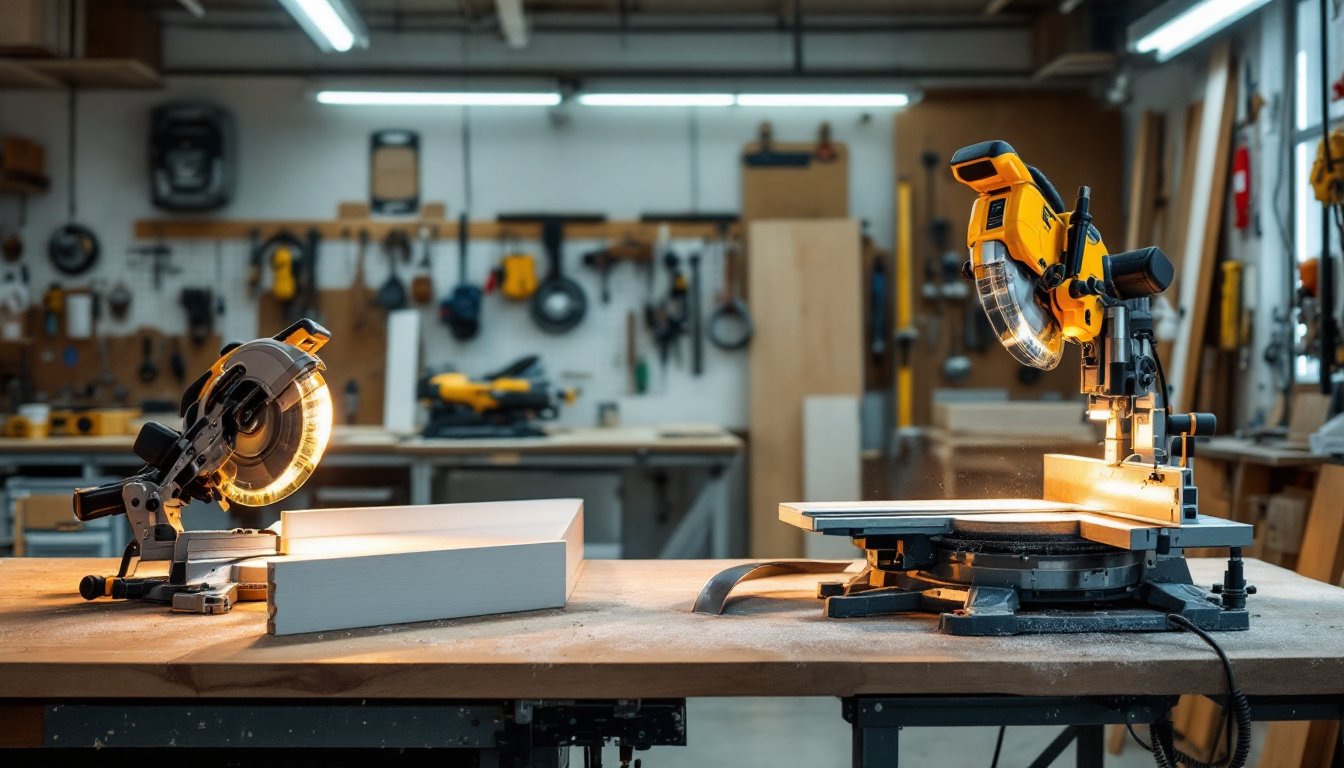
If you’re standing in the tool aisle trying to decide between a miter saw and a chop saw, you’re not alone, and the choice matters. Both tools cut material quickly and accurately, but they’re designed for different jobs. A miter saw excels at angled cuts and trim work, while a chop saw handles straight cuts through heavy materials with raw power. Understanding their strengths means you’ll spend money on the tool that actually fits your workshop and projects. This guide breaks down the real differences so you can make a confident choice.
Table of Contents
ToggleKey Takeaways
- A miter saw excels at angled cuts and trim work with its fine-toothed blade and rotating arm, making it essential for crown molding, baseboards, and finish carpentry projects.
- A chop saw uses a stationary abrasive disc blade designed for straight, heavy-duty cuts through steel, aluminum, and masonry without deflection or precision angle capability.
- Miter saws cost $150 to $1,200+ depending on bevel features and precision, while chop saws are more affordable at $100 to $400, making budget a key consideration.
- Choose a miter saw if your projects demand precise angles and clean wood cuts; choose a chop saw if you primarily work with metal, concrete, or need maximum raw cutting power.
- Miter saws require dedicated bench space (3–4 feet wide), while chop saws are compact and better suited for small workshops, garages, or shared spaces.
Understanding The Key Differences
Blade Design And Cutting Mechanism
The blade is where these two tools diverge fundamentally. A miter saw has a fine-toothed circular blade (typically 10 to 12 inches in diameter) that’s mounted on a pivoting arm. The blade drops down onto material held flat on a table, producing a clean, precise crosscut. The arm rotates side-to-side for angled cuts.
A chop saw, also called an abrasive cutoff saw, uses a stationary disc blade (usually 14 inches) that spins at high speed. You push the material up to the blade rather than dropping the blade onto the work. Chop saws are built heavier and more rigid, designed to absorb the shock of cutting through steel, aluminum, and masonry without deflection.
The blade material matters too. Miter saw blades are toothed carbide-edged steel, optimized for a clean edge on wood and trim. Chop saw blades are abrasive discs, essentially engineered sandpaper bonded to a resin core. That abrasive action generates more heat and dust, which is why chop saws aren’t suited for fine woodworking.
Cutting Angles And Precision
A miter saw shines when angles are involved. Most models tilt the blade side-to-side for miter cuts (0 to 50 degrees) and some tilt the blade front-to-back for bevel cuts. You can make a compound cut, both miter and bevel at once, which is essential for crown molding or intricate trim. The fence and table are indexed, so you can repeat the same angle cut reliably dozens of times.
Chop saws typically make only straight, 90-degree cuts. Some models include a basic angle tilt, but precision is limited, and repeatability is harder to achieve. If your project demands clean, square cuts through pipe, channel, or rebar, a chop saw works fine. But try cutting a 45-degree angle on a piece of trim, and you’ll quickly hit the chop saw’s wall.
Miter Saw: Best For Angled Cuts And Trim Work
Ideal Projects And Materials
Miter saws are the go-to tool for crown molding, baseboards, door casings, and picture frames. The ability to lock in a precise angle, then cut dozens of pieces to length while maintaining that angle, is invaluable for finish carpentry. Homeowners installing new trim or updating interior details find that a miter saw cuts their setup time and improves consistency.
They’re equally at home crosscutting solid wood boards, plywood, and composite materials. A 12-inch miter saw can slice through 2×12 lumber at 90 degrees, and most will handle up to 10-inch width at a 45-degree miter. The clean, splinter-free cut means minimal sanding after, especially important for visible edges.
Miter saws do have limits. They’re not designed for ripping (lengthwise cuts). They can’t handle anything thicker than their maximum crosscut capacity, and curved cuts are off the table. For general trim, framing adjustments, and angled architectural pieces, though, a miter saw is worth the space it takes up in your shop.
Wear eye protection and hearing protection when using a miter saw. The spinning blade and dust ejection can both surprise you. Keep your hands clear of the blade path, and never hold work with your fingers near the cut line. Let the saw do the work, forcing material through is a shortcut to injury.
Chop Saw: Built For Straight, Heavy-Duty Cuts
Chop saws were born in metal fabrication shops and construction sites. If you’re cutting steel angle iron, exhaust pipe, aluminum extrusions, or concrete pavers, a chop saw’s raw cutting power and durability shine. The abrasive blade grinds through hard materials without hesitation, and the tool is built to handle years of heavy use.
The trade-off is speed and precision. A chop saw cut generates a lot of heat. Metal sparks fly in a dramatic arc, which looks aggressive and is aggressive. The blade and workpiece can reach temperatures that would warp or char wood. For steel and masonry, that’s fine. For lumber or trim, it’s overkill and potentially risky.
Chop saws also create dust and particles that are more abrasive than wood dust. A workshop equipped for heavy-duty tool use benefits from a dust collection system or good ventilation. Wear safety glasses, heavy work gloves, and a dust mask or respirator when operating a chop saw. The sparks and particles are persistent and hazardous.
Chop saws are cheaper than comparable miter saws and take up less bench space, they’re compact, bolted to a stand or table. If your projects are mostly straight cuts through metal, concrete, or masonry, a chop saw is the practical choice. If you need precision angles and are primarily working with wood, a miter saw will save you time and frustration.
Cost, Space, And Maintenance Considerations
A basic corded miter saw (10-inch, single-bevel) runs $150 to $300. Dual-bevel models that tilt both directions cost $300 to $600. A compound miter saw with laser guides and improved fences climbs toward $800 to $1,200. You’re paying for repeatability and angle precision, features worth the investment if finish work is part of your routine.
Chop saws are generally less expensive. A 14-inch metal-cutting chop saw costs $100 to $400 depending on motor size and build quality. They’re simpler machines, fewer moving parts, less calibration needed. Over time, the abrasive blade is a consumable cost (expect $15 to $40 per replacement), whereas miter saw blades last longer but cost more upfront ($30 to $80).
Space and storage differ significantly. A miter saw needs a dedicated bench or stand, typically 3 to 4 feet wide. It’s not portable in the traditional sense, though rolling stands exist. A chop saw is compact and easily bolted to a small table or angle-iron cart, making it better for cramped garages or shared workshop spaces.
Maintenance is straightforward for both. Keep the miter saw fence and table clean, check blade alignment occasionally, and tighten bolts. Chop saws need blade replacement more often and benefit from a quick cleanup after each job (metal dust is conductive and can corrode parts). Consult the manufacturer’s manual for your specific model, maintenance instructions vary, and some comprehensive tool reviews and guides cover typical wear and upkeep in detail.
Before buying either tool, measure your shop and honestly assess your projects. If you’re building picture frames and installing trim, a miter saw pays for itself quickly. If you’re cutting rebar and metal studs, a chop saw is the logical investment.